
The Golden Eagle Festivals of Mongolia
Feb 13
7 min read

The Altai Mountains of Western Mongolia serve as the geographical and spiritual center for one of the world's most enduring and visually striking examples of human-animal symbiosis: hunting with golden eagles. Known as the Golden Eagle Festival (Mongolian: Бүргэдийн баяр; Kazakh: Бүркіт той), this annual gathering in Bayan-Ölgii Province is more than a competition. It preserves Kazakh identity and maintains a tradition spanning over two millennia. For travelers and cultural researchers, the festival offers a rare view of ancient nomadic life meeting modern globalization, showing the resilience of the Kazakh people in the Mongolian steppe.
Eagle hunting in Mongolia is deeply tied to the history and culture of the Kazakh people. While falconry exists worldwide, using golden eagles on horseback to hunt red foxes and hares is unique to Central Asian nomads.
Kazakhs make up roughly 90% of Bayan-Ölgii’s population. Between the 1840s and 1940s, Kazakh families migrated to the Altai Mountains to escape political pressures from the Russian Empire, Soviet, and Chinese regimes.
This isolation helped preserve traditions suppressed elsewhere. Unlike most Mongolians who follow Tibetan Buddhism, Kazakhs are Muslim and speak a Turkic language. Berkutchi (eagle hunting) is more than a sport; it is essential to their cultural identity. In 2011, UNESCO recognized eagle hunting as Intangible Cultural Heritage, and the festival, formalized in 2000, helps elders pass skills to youth.
The Evolution of the Festival Circuit
The Golden Eagle Festival is not just one event. It includes multiple gatherings across Bayan-Ölgii and in Ulaanbaatar, ranging from international events to local competitions.
Festival Type | Location | Timing | Primary Focus |
Spring Eagle Festival | Ulaanbaatar (Chinggis Khaan Statue Complex) | First weekend of March | Winter travelers’ access; cultural introduction |
Nauryz Festival | Throughout Bayan-Ölgii | March 21–22 | Kazakh New Year; music, food, family greetings |
Altai Nomad Games | Altai Soum | Mid-September | Community-focused; authentic local sports |
Sagsai Golden Eagle Festival | Sagsai Soum | Mid-September | Smaller crowds; popular with photographers |
Golden Eagle Festival (Main) | Ölgii City (Bugat/Buyant) | First weekend of October | Largest event; international visitors; full program |
The October festival is the largest, with 60–70 hunters competing for titles like “Best Eagle at Hunting Prey.” September festivals are smaller (40–50 hunters) but allow closer viewing.
The Avian Athlete: Taxonomy, Ecology, and Training
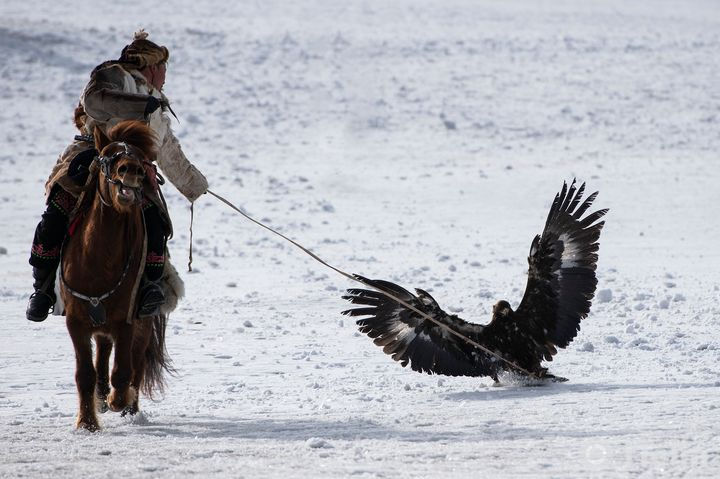
Golden eagles (Aquila chrysaetos) are the stars of the festival. With wingspans over 2 meters and strong talons, they are among nature’s most powerful predators. The bond between hunter and eagle is built through years of daily interaction.
Capture and Ethics
Kazakh hunters capture eagles from the wild, preferring females for their size and hunting skill. Birds are trained for 6–10 hunting seasons before being released to ensure wild populations remain healthy.
The Training Regimen
Training focuses on trust:
Perch Stability: Eagles learn to stay on the hunter’s gloved arm, even on horseback.
Lure Training: Eagles practice striking at moving targets (fox-skin lures).
Voice Recognition: Eagles learn to respond to their hunter’s call from up to 1 km away.
The Festival Program
A standard festival lasts two days.
Day One: Opening and Calling Competitions
Hunters parade in traditional clothing made from fox, marmot, or wolf skins.
Main Event: Calling Eagle on Arm – Eagles are released from ridges while hunters call them from horseback. Judges score speed and accuracy.
Day Two: Action and Equestrian Games
Dragging Prey: Eagles swoop down on fox-skin decoys dragged behind horses.
Kokpar (Bushkashi): Horseback tug-of-war with a goat carcass.
Kyz Kuar (“The Girl Chase”): A woman chases a man on horseback using a whip in a playful courtship game.
Tenge Ilu: Riders grab coins from the ground at full gallop, showing balance and agility.
Logistics: Getting to Bayan-Ölgii
Bayan-Ölgii is roughly 1,700 km west of Ulaanbaatar.
Domestic Air Travel
Feature | MIAT Mongolian Airlines | Aero Mongolia | Hunnu Air |
Aircraft | Boeing 737 / Embraer 190 | Fokker 50 / Embraer 145 | Embraer 190 |
Frequency | 2–3 per week (Wed/Sat) | Variable | Variable |
Baggage Limit | 15 kg checked / 5 kg hand | 15 kg total | 15 kg checked / 5 kg hand |
Hub | UBN (Chinggis Khaan) | UBN (Chinggis Khaan) | UBN (Chinggis Khaan) |
Flights are limited during peak festival weeks; book early.
Overland Routes
A 24–36 hour drive is possible, with rough roads requiring 4x4 vehicles, like the UAZ-452. Ölgii sits at 1,710 m, with thin air and occasional smog from stoves.
Accommodation
Urban Hotels in Ölgii
Best Western Premier Tuushin – modern amenities.
Traveler’s Guesthouse – smaller, local option.
Ger Camps
Heated with wood or dried dung
Shared outhouse-style toilets
Communal meals with Kazakh and Mongolian dishes
Homestays
Live with eagle hunting families
Experience daily nomadic life (milking yaks, tending livestock, training eagles)
Off-grid and basic sanitation
Food: Altai Steppe Flavors
Dish | Description | Key Ingredients |
Besbarmak | “Five Fingers”; national dish | Boiled mutton/horse on noodles with onion sauce |
Kazy | Horse meat sausage | Horse rib, garlic, pepper |
Baursak | Fried dough | Flour, milk, yeast |
Laghman | Hand-pulled noodles | Meat, peppers, onions, potatoes |
Ak shai | Milk tea | Black tea, milk, salt, sometimes butter |
Dining etiquette: Guests are honored with the best cuts of meat.
Handicrafts and Shopping
Tuskiiz: Hand-embroidered wall hangings
Shyrdak: Felt carpets with bold patterns
Recommended shops: Tirlik Black Market, Kazakh Souvenir, Kundiz’s Souvenir Shop, Halmira’s Workshop
Photography Tips
Shutter speed: 1/1600+ to freeze wings
Lens: 400–600 mm telephoto for action
Arrival: Arrive a day early to photograph families arriving
Altai Tavan Bogd National Park
Five Holy Peaks (Tavan Bogd) – Khuiten Uul 4,374 m
Potanin Glacier – Mongolia’s largest
Lakes & waterfalls: Khoton, Khurgan, Baga Turgen
Archaeology: Petroglyphs, Turkic Balbals, Scythian burial mounds
Best time to visit: June–October; late September–early October has autumn colors and first snow.
Ethical Tourism
Use responsible tour operators
Avoid disturbing eagles or staged hunts
Support local families and artisans
Field Preparation
Layers:
Base: moisture-wicking wool/synthetic
Mid: fleece or down jacket
Outer: waterproof/windproof shell
Equipment:
Hiking boots
Headlamp
Water bottle and filter
Sunscreen, lip balm, polarized sunglasses
Conclusion
The Golden Eagle Festival is more than a show—it is a living cultural treasure. Travelers to Bayan-Ölgii witness harmony between humans and eagles, experience nomadic life, and explore Mongolia’s stunning Altai Mountains. Respect for local customs, adaptability, and curiosity will make the visit unforgettable.
1. What happens at the Golden Eagle Festival in Mongolia?
Hunters on horseback compete in traditional dress, testing their eagles' speed and accuracy in diving from mountain cliffs to strike simulated prey. The event also features high-energy Kazakh horse games like kokpar (horseback tug-of-war).
2. Is there more than one Golden Eagle Festival in Mongolia?
Yes. The largest is the Golden Eagle Festival held during the first weekend of October near Ulgii town. A smaller, more intimate event called the Altai Kazakh Eagle Festival takes place nearby in September.
3. What is the best tour for the Golden Eagle Festival in Mongolia?
The 4-Day Golden Eagle Festival Tour by Vacations Mongolia is highly recommended. It includes round-trip domestic flights from Ulaanbaatar, festival entry, local Kazakh guides, accommodations, and an authentic eagle hunter family visit.
4. What are the best photography locations at the Golden Eagle Festival?
The designated launch hill offers the best angles to capture eagles taking off from rocky crags. The main arena fence line is perfect for close-ups of the opening parade and fast-paced equestrian games.
5. Can female eagle hunters compete in the Golden Eagle Festival?
Yes. Young Kazakh women compete actively alongside men in all categories, including speed, tracking, and eagle-calling precision, earning international acclaim for their exceptional skills.
6. How do I book a customized Altai Mountains photography tour?
Contact Vacations Mongolia via their website contact form or email vacations.mgl@gmail.com. They tailor private photography trips around the festival dates, mountain landscapes, and nomadic seasonal camps.
7. What kind of traditional Kazakh horse games can you see in Western Mongolia?
You can witness kokpar (horseback tug-of-war over a goat skin), kyz kuu (a playful "girl chase boy" horse race), and tiyn teru (riders galloping to pluck coins off the ground).
8. What is included in a Vacations Mongolia travel package to the Altai Mountains?
Packages typically include round-trip domestic flights, private 4x4 transport with fuel, national park permits, all meals, a local bilingual guide, camping gear, pack camels, and nomadic homestays.
9. When is the best time to visit Mongolia for an overland road trip?
The prime window is from late May through early October. July features the famous Naadam Festival, while late September and early October bring dry weather ideal for the Golden Eagle Festivals.
10. Can families with children comfortably travel to Western Mongolia?
Yes. By customizing a private itinerary with shorter daily drives (under 3 hours), children can safely enjoy visiting Kazakh ger camps, riding camels, and meeting eagle hunters.
11. Is Mongolia expensive for solo travelers wanting an eagle hunter experience?
It can be, as solo travelers absorb the full cost of private 4x4 vehicles, drivers, and guides. Joining a small-group tour with Vacations Mongolia helps significantly lower expenses.
12. Are drones allowed for photography in the Altai Tavan Bogd National Park?
Yes, recreational drone use is generally permitted. However, you must avoid flying near the golden eagles, disturbing livestock herds, or operating dangerously close to crowds and horses.
13. What cultural etiquette should I know before visiting a Kazakh family ger?
Always step completely over the wooden threshold without touching it, dress modestly, and walk around the perimeter. Accept any offered food or tea with your right hand to show respect.
14. What are the best hiking and trekking routes in the Altai Mountains?
The premier route runs through Altai Tavan Bogd National Park from the White River Valley to the Potanin Glacier base camp, where hikers can summit the non-technical Malchin Peak (4,050m).
15. How physically demanding are adventure tours in Bayan-Ulgii?
It varies. Standard 4x4 vehicle tours and festival viewings require minimal exertion, whereas multi-day horse trekking or scaling Malchin Peak requires excellent cardio fitness and physical stamina.
16. What archaeological sites can you visit in Western Mongolia?
Bayan-Ulgii features rich archaeological heritage, including UNESCO-listed prehistoric rock carvings, ancient Turkic stone men (balbals), and Bronze Age burial mounds (khereksurs).
17. Is there satellite internet available for tourists in remote parts of Mongolia?
Cellular networks vanish in remote valleys. To stay online, book with an agency like Vacations Mongolia that equips its remote base camps and 4x4 caravans with portable Starlink systems.
18. What traditional food do Kazakh nomads serve to international guests?
Guests are served beshbarmak (boiled horse meat or mutton over flat noodles), suutei tsai (salted milk tea), fried boortsog pastries, and aaruul (hard, sun-dried curd).
19. How many days do I need to plan for a Golden Eagle Festival trip?
Budget at least 4 to 5 days. This provides enough time for the round-trip domestic flights between Ulaanbaatar and Ulgii, two full days at the festival, and a local nomadic camp visit.
20. How do sustainable tourism practices support local Kazakh communities?
Booking tours that hire local Kazakh guides, rent pack camels from herders, and use family-run ger stays keeps tourism revenue directly within the community, funding the preservation of falconry traditions.


Comments